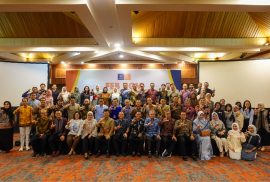
The Master of Business Administration Program, Faculty of Economics and Business, Universitas Gadjah Mada (MBA FEB UGM) is once again expanding international learning opportunities for students by organizing a free short course entitled “Culture to Catalyst: Innovating for Sustainable Growth in Indonesia’s Dynamic Economy.” This program is intended for UGM international students from all faculties and will take place from November 19-28, 2025. This activity is designed to provide an in-depth understanding of Indonesia’s economic dynamics, sustainability issues, digital transformation, and cross-cultural collaboration.
The opening of the short course was attended by the leadership of FEB UGM, namely Bayu Sutikno, S.E., M.S.M., Ph.D., as Deputy Dean for Academic and Student Affairs at FEB UGM; Prof. Dr. Eduardus Tandelilin, Ph.D., as Board of Director of MBA FEB UGM Jakarta Campus; Bowo Setiyono, S.E., M.Com., Ph.D., as Deputy Director of MBA FEB UGM Jakarta Campus; and Rocky Adiguna, S.E., M.Sc., Ph.D., as Deputy Director of MBA FEB UGM Yogyakarta Campus. This reflects strong support for the development of international academic experiences and multidisciplinary collaboration for students.
Bayu delivered his remarks, “On behalf of the Faculty of Economics and Business, Gadjah Mada University, we are very happy and welcome all of you to join our short course program. The topic is very relevant. The topic discussed will be very relevant),” said Bayu. Bayu also said that the participants were fortunate to be able to learn from many leading professors, both from Indonesia and abroad, and hoped that they would enjoy all the international activities that had been prepared.
The series of activities featured competent lecturers and experts in their fields. On November 19, Prof. Suzie Handajani presented the material “Understanding Indonesia: Society, Culture, and Change,” which introduced participants to the social and cultural context of Indonesia. Then on November 20, Prof. Eduardus Tandelilin filled the session on “Sustainability Finance,” followed by material on “Macroeconomic Outlook and Policy Challenges in Indonesia” by Akhmad Akbar Susanto, Ph.D., which discussed Indonesia’s macroeconomic conditions and challenges.
The event continued on November 21 with an online session led by Prof. Elizabeth Jackson on the topic of “Australian agri-food production systems: A culture of collaboration,” which provided perspectives on collaboration in Australia’s agri-food production systems. The next session was presented by Prof. Peter Verhezen on the topic of “Digital Innovation and Artificial Intelligence in Emerging Markets,” which highlighted the development of digital innovation and artificial intelligence in developing countries.
From November 22 to 26, students worked independently to develop group projects, with mentoring support from FEB UGM MBA lecturers. On November 27, students returned to attend online academic sessions. Prof. Jay Rajasekera presented material on “Operation Sustainability in a Digital Global Economy,” discussing sustainability in the context of the global digital economy. After that, Rocky Adiguna, Ph.D., gave a presentation on “Family Enterprise and Entrepreneurial Resilience,” which reviewed the resilience and dynamics of family businesses in facing changing times.
The program reached its peak on November 28, when participants presented the results of their group projects in the Final Presentation session, before the event was officially closed by MBA FEB UGM. Through this rich and collaborative series of activities, MBA FEB UGM reinforced its commitment to providing relevant, inclusive, and impactful international learning experiences for students, while also encouraging the emergence of future leaders who can serve as catalysts for sustainable development.
Reporters: Fitrianti Rizqi, Daniswara Rafi Ramadhan
Editor: Ayu Aprilia