Jakarta, May 8th 2026
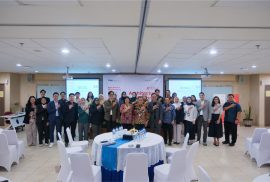
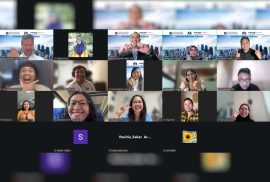
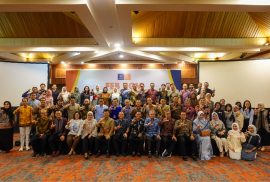
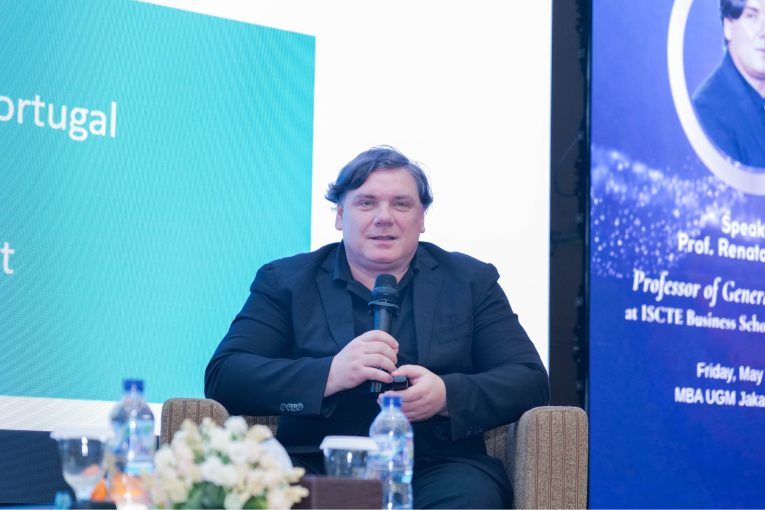
In the middle of uncertain global geopolitical change, the business sector is required to adapt and beyond the conventional boundaries. Among the challenges currently faced by the business sector leaders are inter-state conflicts, trade wars, supply chain fragmentation, and a realignment of global economic power. In preparation for addressing these challenges, MBA FEB UGM Jakarta Campus held an Executive Series under the theme “Business Beyond Borders: Leading Through Geopolitical Change”. The event featured the expertise of Prof. Renato Pereira, Professor of General Management from ISCTE Business School, Lisbon, Portugal, moderated by Dr. Rangga Almahendra, S.T., M.M., on Friday, May 8th 2026.
The event was opened by the Deputy Director of MBA FEB UGM Jakarta Campus, Sari Sitalaksmi, Ph.D. She stated that the topic presented was highly relevant to the conditions currently experienced by students in their daily business activities. “For the past several months, Indonesia and the world have been facing significant geopolitical turbulence. Our students are very much aware of what is happening in their businesses,” she stated. On the same occasion, she also announced a new concentration called Strategic Leadership, Organizational Design, and Culture, which has been officially launched as a form of the program’s commitment to addressing the need for leadership development relevant to the advancement of the times.
Opening his presentation, Prof. Renato outlined his identification of five major geopolitical trends currently shaking the business world. First, the rivalry between the United States and China in competing for global economic dominance. He revealed that it is not merely about the United States’ dominance over the global economy, but also encompasses military power, control over international financial institutions, and the soft power that has been built over decades. Second, the instability of the global financial system, which relies on the printing of money without real value. Currently, nearly all major countries are pushing their debt to its maximum point, and at some point in the future, the world will be forced to carry out a collective debt write-off, as there will be no other way to manage it.
Third, the impact of climate change, which threatens the world’s food supply chain. Some countries have lost up to half of their productive agricultural land due to desertification. Natural resources that were previously inaccessible have now become a new arena of geopolitical competition. Climate change has the potential to trigger new disease outbreaks and reactivate previously dormant viruses. This will also create new disparities between countries that provide medical technology and those that do not.
The fourth trend is slowlization, or the weakening of globalization flows. Prof. Renato asserted that a purely global strategy will become the exception, not the norm, in the future. Domestic and regional strategies will carry far greater weight. Technological advancement enables businesses to operate fully without a physical presence, opening opportunities for developing countries, particularly Indonesia to enter global supply chains without the need for massive physical investment.
Last, the fifth trend is the era of the “never normal,” marked by never ending conflicts such as the wars in Ukraine, Gaza, and Iran. Conflicts continue to smolder without any clear resolution, creating a state of permanent uncertainty. This never normal condition is fundamentally changing the way we formulate business strategies.
During the discussion session, Prof. Renato stressed that geopolitical change not only presents threats, but also real opportunities, particularly for countries in the Southeast Asian region. He highlighted how COVID-19 prompted many European countries to sever their dependence on China and actively seek alternative supply chain partners. Drawing on international trade data, he illustrated how China’s market share surged from less than 1% in 1979 to nearly 15% today, surpassing the United States, which has actually declined from 11% to 8%. Unfortunately, however, Indonesia has yet to take on a greater role or shown ambition to develop in this area, yet without ambition and strategy, no change will come.
On another note, leadership skills are now more critically needed than ever. Prof. Renato asserted that today’s leaders can no longer run businesses by avoiding risk, but must instead embrace it. “We need to revive the entrepreneurial spirit. Out of ten strategies launched, perhaps only one will succeed, and that is perfectly normal. Learn from the process,” he explained. He also reminded the audience that business frameworks serve only as support, not as a substitute for genuine human leadership.
As a closing, Dr. Rangga summarized the VUCA framework, addressing Volatility with Vision, Uncertainty with Understanding, Complexity with Clarity, and Ambiguity with Agility. Through this Executive Series, it is hoped that students will be equipped not only with technical business knowledge, but also with sensitivity to global issues that directly influence strategic decision-making at both the corporate and national levels. Beyond that, MBA FEB UGM Jakarta Campus reaffirmed its commitment to delivering relevant and in-depth international perspectives for Indonesia’s future business leaders.
Humas: Suci Hapsari
Photografer: Alfian Rama Aditya