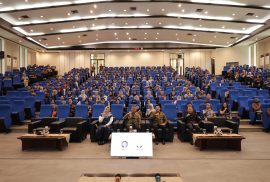
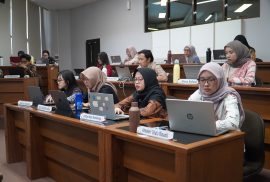
Jakarta, 24 July 2026 – The Indonesian Master of Management Program Alliance (APMMI) successfully held a national webinar titled Green Economy for Sustainable Business: Building Competitive Advantage through Innovation and Sustainable Leadership on Friday, 24 April 2026. The event brought together more than 480 participants, comprising students and lecturers from Master of Management programmes across APMMI member institutions throughout Indonesia. The webinar was officially opened by Prof. Amin Wibowo, Ph.D., Chairman of APMMI, and moderated by Prof. Rofikoh Rokhim, Ph.D.
The webinar featured Tandean Rustandy, MBA, Chief Executive Officer of PT Arwana Citramulia Tbk, who shared the company’s experience in embedding Environmental, Social, and Governance (ESG) principles into its corporate strategy to drive sustainable business growth. Through the theme Green Economy for Sustainable Business, he emphasised that sustainability is no longer merely a regulatory obligation but has become a strategic driver of innovation, resilience, and long-term competitive advantage.
During his presentation, Tandean explained that investments in sustainability should be viewed as long-term strategic investments rather than additional business costs. Although adopting environmentally friendly technologies often requires significant upfront capital, initiatives such as improving energy efficiency, optimising water consumption, and enhancing production processes have proven effective in reducing the Cost of Goods Sold (COGS) over time.
In addition to improving operational efficiency, companies with strong ESG performance have greater opportunities to access green financing with more competitive funding costs. This allows businesses to maintain profitability while strengthening investor confidence and enhancing long-term business resilience.
The speaker further highlighted the importance of implementing a circular economy as a key enabler of Indonesia’s Net Zero Emissions ambitions. According to him, the greatest challenge lies not only in technological capabilities but also in the readiness of the country’s supply chain ecosystem. Infrastructure for the collection, processing, and reuse of industrial waste still requires significant improvement, while ensuring the consistent quality of recycled raw materials remains a major concern. As a result, the successful implementation of a circular economy requires close collaboration among businesses, government, academia, and all stakeholders across the supply chain.
Building on this point, Tandean emphasised that the transition towards a green economy must be embedded within a company’s core business strategy rather than being treated merely as a Corporate Social Responsibility (CSR) initiative. ESG principles should be integrated into corporate decision-making through strong top management commitment and translated into measurable operational and financial targets. By adopting this approach, companies can drive sustainable innovation that not only supports long-term business continuity but also creates lasting competitive advantages in an increasingly dynamic global market.
Through this webinar, APMMI reaffirmed its commitment to providing an academic platform that strengthens collaboration between universities and industry. By facilitating discussions on ESG implementation and sustainable business practices, the association aims to broaden the perspectives of students and academics while contributing to the development of innovative, adaptive, and sustainability-oriented business leaders in Indonesia.